
The trouble with an office clean is rarely one specific dirty thing. It is a pattern. One week the kitchen is spotless and the bins are full. The next week the bins are done and the meeting room has not been touched. A new face turns up, does not know where the vacuum lives, and asks the receptionist. Somebody in the office ends up writing a list, then chasing the list, then chasing the invoice for the things on the list that did not happen.
That is a person being paid to run a building spending their week running a cleaner, and it is the thing our commercial contracts are built to remove.
Why the standard drifts
The standard drifts because nothing is written down and the people change. If the scope lives in one cleaner's head, it leaves when they do. If the crew is pulled from a pool, the pool does not know your building. And if nobody above the cleaner ever walks the floor, the only quality control is the complaint.
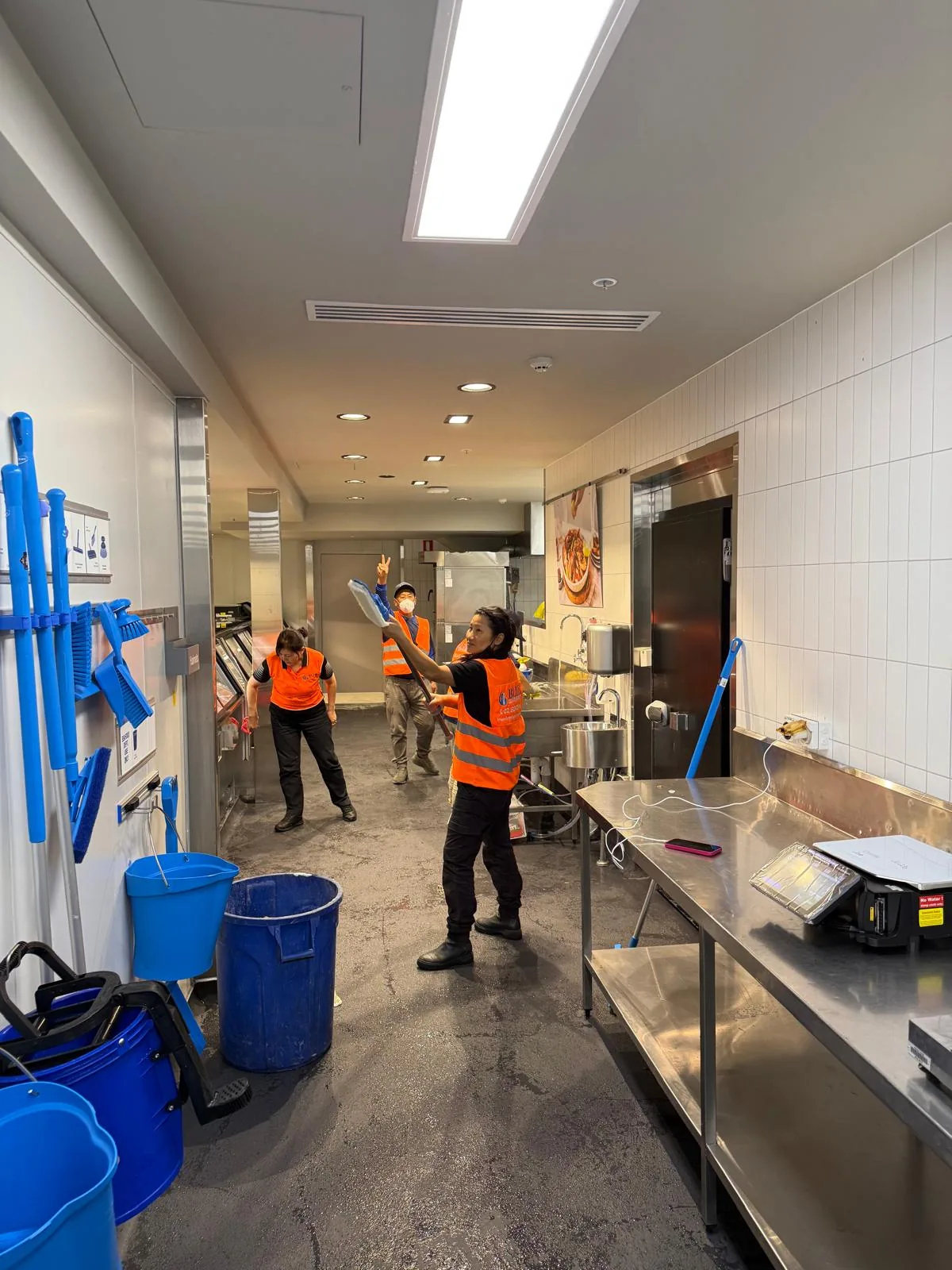
Our cleaners are employed directly, trained on our systems, products and equipment, and part of a team that looks after each other. That is not a slogan on this site, it is the operating model, and it is why a building on our books sees the same people. Twenty-eight service locations are on ongoing contracts with us, some of them daily, some weekly, some fortnightly.
What is written down before anybody signs
An office comes onto our books in three stages, and the first one is a visit, not a quote.
The walk-through
Before anything is priced, one of our people walks the office, after hours if that is when the cleaning would happen, and scores what they find against a ten-point checklist. The scope and the interval come out of that walk rather than out of a floor plan or a price list. It costs nothing, and it ends in a clear quote and a contract you accept or decline. Either answer is fine.
The deep clean
The first visit is a deep clean. It sets the baseline, so the routine starts from clean rather than from wherever the last contract left it. Depending on how the building is used, further deep cleans are scheduled quarterly, twice a year or yearly, and that schedule is written for the year ahead at the start.
The maintenance plan, and the supervisor
Then the routine begins, and a supervisor keeps watching it. Supervisors continuously monitor the cleaning teams and adjust the plan as the building changes: a floor fills up, a tenancy empties, a kitchen gets busier. Supervision is part of what you are buying, not a favour, and it is the mechanism that replaces the list on the office manager's desk. The full three stages are on our how we work page.
The scope of an office contract
For an office the scope is six lines, the same six on every visit: vacuuming and mopping floors, dusting and wiping surfaces, sanitising the high-touch areas, cleaning the kitchens and bathrooms, emptying the bins, and cleaning the common areas. Anything the office needs beyond them goes in as its own line, carpet extraction, internal glass, a periodic deep clean, so there is never an argument later about what was included.
Washroom paper, hand towel and soap are supplied and restocked on the same contract. Running out is our problem to notice, not yours.
Cleaned around the hours you keep. Weekly, fortnightly or monthly, after hours where the floor is busy, or during the day where a building wants to see who is in it. The interval is set from the walk-through, not from a price list.
What it costs you when it goes wrong
Not the invoice. The cost is the hours a salaried person spends on it, the meeting room that was not ready when the client arrived, and the quiet judgement visitors make about a building from its bathrooms. A written routine, the same crew and a supervisor are how those costs come off your desk.
If you are managing your cleaner, book the walk-through. It is free, and the quote that follows it is a quote, not an opening position. Details on the office cleaning page.